
Strengthening the Foundations: Inside HPFPI’s Strategic Planning and Governance Review

In the pursuit of sustainable, climate-resilient housing for rurban poor communities, structural alignment and strong grassroots leadership are utterly significant. Moving from localized success to systemic, scalable impact requires intentional self-reflection, strategic planning, and a clear, shared vision.
To chart this path forward, the Homeless People’s Federation Philippines, Inc. (HPFPI), with the invaluable support of the Philippine Alliance (PACSII), convened a pivotal two-day Strategic Plan Preparatory Meeting. Anchored deeply in Project RURBANISE vision, this session brought together HPFPI national office leaders, community heads from across the Rurbanise networks, PACSII, and TAMPEI (Technical Assistance Movement for People and Environment, Inc.).
The goal was to revisit the Federation’s rich history, critically assess its current organizational architecture, and lay the groundwork for a deeply rooted, climate-resilient housing strategy.
Introspection, Leadership Journeys, and Historical Mapping
The first day of the assembly centered on deep personal and organizational alignment. Before projecting future goals, leaders took a step back to ground themselves in their collective mission.
The meeting opened with a structured onboarding session where participants outlined their individual objectives and expectations. Crucially, facilitators contextualized the strategic link between HPFPI’s strategic plans and the RURBANISE objectives. Leaders openly addressed the inherent limitations the Federation faces when navigating deeper structural barriers, such as tenure security.

Through expressive drawings and emotional reflections, the community leaders visualized their personal leadership journeys. The discussion framed leadership not merely as an administrative role, but as a process requiring affection, stillness, and resilience.
A core highlight of Day 1 was the construction of a Historical Timeline. Leaders mapped out regional histories, organizational milestones, and historical hurdles. This retrospective phase opened critical dialogues regarding land and housing tenure, savings programs, knowledge transfer, and leadership transitions within communities. The day concluded with leaders pondering on the Federation’s mission and vision, and assessing the specific metrics of community savings and housing access within their respective regions.

Diagnostic Evaluation and Governance Restructuring
To evaluate how effectively the Federation operates as a non-profit, the Day 2 session introduced McKinsey’s 7S Model. This tool allowed leaders to look beyond basic operations and examine how "Soft" elements (Shared values, Skills, Style, Staff) interact and align with "Hard" elements (Structure, Strategy, Systems). Emphasis was placed on leadership tasks such as defining and embodying purpose.
The discussion highlighted the collective critique of HPFPI’s mission and vision statement. Finding it too verbose for easy recall, the body collaboratively drafted a clear, concise, inclusive and empowering alternative. The revised working statements focused squarely on delivering secure, sustainable, and dignified living for formerly informal settlers.

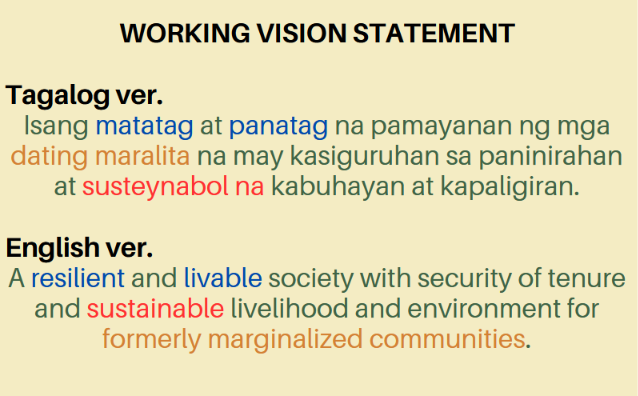
During the session, leaders engaged in a transparent dialogue regarding current operational bottlenecks, identifying critical opportunities to streamline coordination between local, regional, and national bodies. Key areas for development were identified:
Balancing Local and Regional Priorities
Leaders discussed the need to strengthen regional council integration—particularly within the extensive networks like the National Capital Region (NCR). The group emphasized moving from isolated local projects to a unified regional approach, consequently ensuring smoother nationwide program delivery.
Clarifying Governance vs. Executive Execution
To optimize efficiency, participants called for a clearer distinction between policymaking bodies (the councils) and executive bodies (the regional implementing offices). Establishing precise legal and operational mandates will clarify roles and enhance accountability for regional coordinators.
Reviewing Institutional Bylaws
In the spirit of transparency and sound risk management, the structure of the Executive Committee was evaluated. Participants recommended a comprehensive review of the bylaws to ensure strict structural independence, specifically safeguarding the objective oversight role of the internal audit function.
Standardizing Network Compliance
To maintain the long-term integrity of the Federation, leaders proposed formalizing the National Office as a Secretariat and establishing structured Regional Offices. Furthermore, the body discussed instituting a standardized compliance framework for member-HOAs, ensuring that leadership roles are held by active, fully compliant associations.

Action Points and Next Steps
To turn these high-level discussions into measurable outcomes, the assembly established a clear, immediate action plan:
|
|
|
|
True climate resilience needs strong organizational foundations. By taking the time to pause, reflect, and redesign its internal governance, HPFPI is ensuring that its leadership structures are just as durable as the housing communities they build. Through the combined strengths of Project RURBANISE consortium, the Federation is moving forward with a renewed sense of purpose. Armed with clear action points, a streamlined vision, and an unwavering commitment to structural transparency, HPFPI is uniquely positioned to transform grassroots efforts into lasting, nationwide impact—one secure, sustainable, and dignified community at a time.
—
Through long-term commitments and partnerships worldwide, and needs-driven, action-focused research, CLARE links up short-and long-term issues, enabling long-term, sustainable, and fair economic and social development in a changing climate whilst supporting early action to reduce impacts of climate variability whilst providing a better understanding of the risks associated with climate.
Reference:
The Strategy Institute. (17 May 2024). The McKinsey 7-S Model for Organizational Alignment and Success. Retrieved from https://www.thestrategyinstitute.org/insights/the-mckinsey-7-s-model-for-organizational-alignment-and-success

About the Author
Janina Salubo is a Knowledge Management and Development Communications Volunteer for the RURBANISE project, specializing in translating complex resilience research into accessible insights for funders and grassroots communities.